
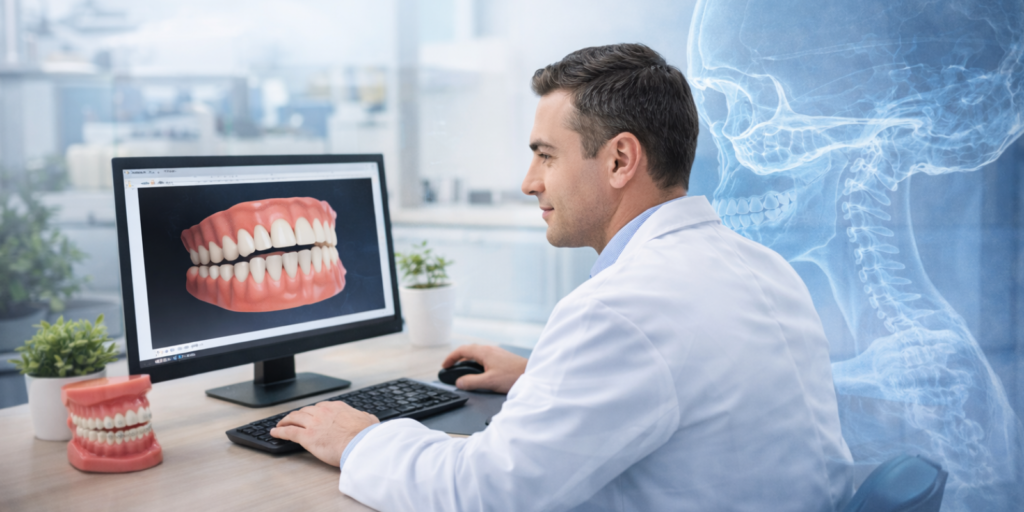
If you have ever sat in an orthodontic chair and wondered how your doctor actually knows where each tooth needs to go, you are about to get a really satisfying answer. The way orthodontists plan treatments today looks almost nothing like it did even ten years ago. And if you are currently exploring your options for teeth straightening, understanding what goes on behind the scenes will give you a whole new level of confidence in the process. Let us get into it.
Maintain a healthy smile by brushing and flossing daily, visiting the dentist regularly, eating a balanced diet, avoiding sugary foods, staying hydrated, and using mouthwash for added protection.
From Guesswork to Precision: What Changed and Why It Matters
Not too long ago, orthodontic treatment planning relied heavily on physical plaster models of your teeth, two dimensional X-rays, and a significant amount of clinical intuition. Your orthodontist would study those models, look at your X-rays, and essentially map out a treatment plan in their head. Skilled, yes. But limited.
3D treatment planning changed everything. Today, a digital scan of your mouth can be taken in minutes, producing a highly accurate three-dimensional model of your teeth, your bite, and your jaw structure. From that single scan, your orthodontist or treatment planning team can simulate exactly how your teeth will move, identify potential issues before they arise, and build a treatment plan that is precise down to fractions of a millimeter.
A study published in the American Journal of Orthodontics and Dentofacial Orthopedics found that 3D digital models are as accurate as traditional plaster models for orthodontic measurements, with the added advantage of being instantly shareable, storable, and adjustable.
That last part matters more than people realize. When your treatment plan can be adjusted digitally before a single tray is made or a single bracket is placed, the margin for error shrinks dramatically.
What the 3D Planning Process Actually Looks Like
Here is what typically happens when 3D treatment planning is part of your care.
You come in for a scan. Instead of the old-fashioned impressions where you had to bite down into a tray of goopy material for several minutes, an intraoral scanner moves around your mouth and captures thousands of data points in real time. The whole thing usually takes under five minutes and is genuinely comfortable.
That scan gets uploaded into specialist software, where a treatment planning team maps out your entire tooth movement journey. Every single tooth movement is calculated, sequenced, and reviewed. You can often see a simulation of what your smile will look like at the end of treatment before you even begin.
From there, your aligners or appliances are manufactured to match that precise digital plan. Nothing is estimated. Nothing is approximate. It is all mapped out before anything physical is created. According to a report by MarketsandMarkets, the global dental 3D imaging market is expected to grow from $2.9 billion in 2022 to over $5.1 billion by 2027, driven largely by the rising adoption of digital orthodontic workflows.
That growth tells you something important. Clinics and labs around the world are investing heavily in this technology because the results speak for themselves. Are you curious what a 3D treatment plan would look like for your smile? Get in touch with The Smile Correct, and we will show you exactly what is possible.
Why This Is a Game Changer for Patients
You might be thinking, okay, this sounds impressive, but how does it actually affect me as a patient? The answer is more than you might expect.
- First, your treatment is more predictable. Because every movement is planned in advance and simulated digitally, your orthodontist has a much clearer picture of how your case will progress. Surprises mid-treatment become far less common.
- Second, your treatment can be faster. When the planning is precise, teeth move more efficiently. There is less trial and error, fewer adjustment visits, and in many cases shorter overall treatment times.
- Third, communication improves significantly. Your orthodontist can show you your treatment simulation on a screen, walk you through each stage, and have a real conversation with you about what to expect. That kind of transparency builds trust and helps you stay motivated throughout your treatment.
A clinical review published in the Journal of World Federation of Orthodontists found that digital treatment planning tools significantly improved treatment efficiency and patient understanding of their orthodontic outcomes compared to traditional planning methods.
When you actually understand what is happening with your own teeth, you tend to be more engaged, more compliant, and more satisfied with the outcome. That is a win for everyone involved. Ready to experience treatment that is planned with this level of care and precision? The Smile Correct is here to walk you through it.
What This Means for the Future of Orthodontics
We are honestly just getting started. Artificial intelligence is now being integrated into 3D planning software, meaning the systems themselves can flag potential issues, suggest optimal tooth movement sequences, and even predict how bone and tissue will respond to treatment over time.
Orthodontists who embrace this technology are not just keeping up with trends. They are genuinely delivering better outcomes for their patients. And patients who choose providers using advanced 3D planning are getting a level of care that simply was not available to previous generations.
Research from the European Journal of Orthodontics highlights that AI-assisted digital planning has already demonstrated the ability to reduce human error in treatment sequencing and improve overall treatment outcomes in complex cases.
The bottom line is this. If your smile matters to you, the quality of your treatment plan matters just as much as the quality of your aligners or braces. One without the other will only get you so far. At The Smile Correct, precision 3D treatment planning is at the core of everything we do. We combine expert clinical knowledge with the latest digital tools to make sure every patient gets a plan that is built specifically for them, not just a template with their name on it.