
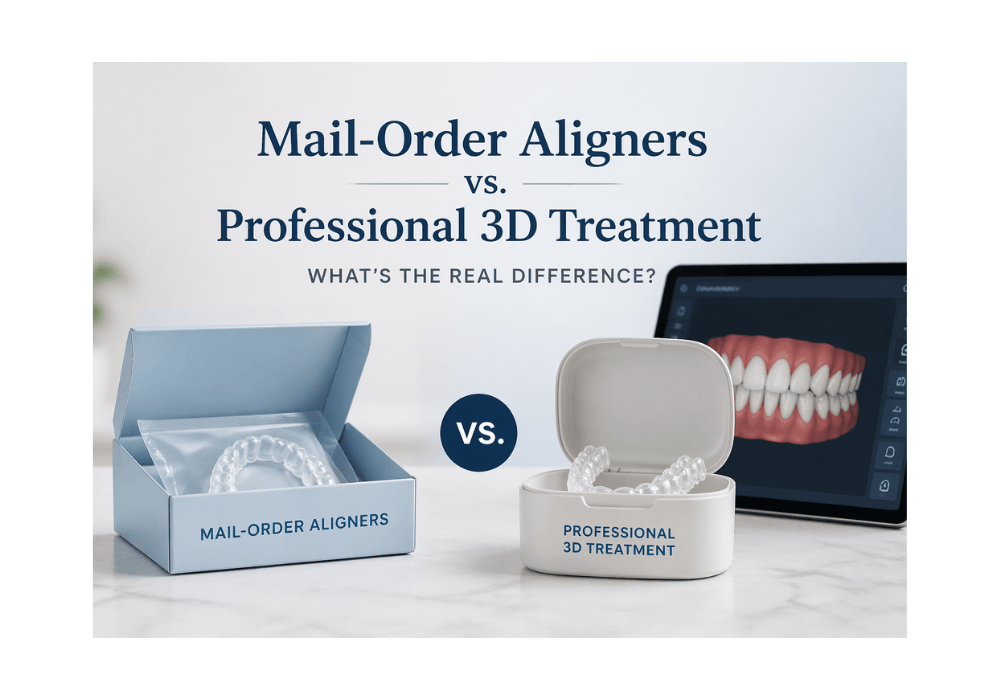
Clear aligners have made orthodontic care more accessible than ever. The convenience of straightening teeth from home with mail-order aligners can be appealing, but this convenience often comes at a hidden cost. Professional 3D treatment planning, supervised by orthodontists, ensures safe, predictable, and long-lasting results. Understanding the differences is critical for anyone considering clear aligner treatment.
Maintain a healthy smile by brushing and flossing daily, visiting the dentist regularly, eating a balanced diet, avoiding sugary foods, staying hydrated, and using mouthwash for added protection.
Mail-Order Aligners: Convenience Comes with Risks
Mail-order aligners are marketed as affordable, simple, and efficient. Patients typically take impressions at home or use a scanning kit and then receive a series of aligners shipped directly to them. While this may work for very minor cosmetic adjustments, it skips critical steps of proper orthodontic care:
- No in-person evaluation of gums, bones, or bite
- Limited ability to identify underlying oral health issues
- No real-time monitoring of tooth movement
- Lack of personalized refinements during treatment
These limitations can result in complications that may not be immediately obvious but could require expensive corrective procedures later. Gum recession, root shortening, bite misalignment, and even jaw joint problems are all potential consequences of unsupervised treatment.
Professional 3D Treatment Planning: Precision and Oversight
Professional 3D treatment planning begins with a comprehensive examination, including X-rays, bite evaluation, and assessment of gum and bone health. Using advanced digital technology, orthodontists simulate the movement of each tooth before treatment begins. This allows for precise sequencing, the strategic placement of attachments, and necessary interproximal reduction (IPR) if needed.
Regular in-office monitoring ensures teeth are moving as planned. Refinements can be made along the way to address tracking issues or unexpected biological responses. This supervision dramatically reduces the risk of complications while improving efficiency and predictability.
Understanding the Real Cost
Price alone does not reflect the true cost of treatment. Mail-order aligners may seem cheaper initially, but the lack of supervision and diagnostics introduces hidden costs:
- Potential need for corrective procedures if complications arise
- Extended treatment time due to misalignment or poor tracking
- Long-term dental issues such as bite problems or gum recession
Professional treatment, while more expensive upfront, minimizes these risks and ensures outcomes that are both functional and aesthetic. The investment in proper oversight often saves time, money, and stress over the course of treatment.
Who Benefits from Mail-Order Aligners?
Mail-order aligners are generally limited to very mild cases, such as small cosmetic spacing or minor crowding. Patients with more complex dental issues—rotated teeth, severe crowding, bite discrepancies, or jaw alignment problems—require professional supervision to achieve safe and effective results.
Even simple cases benefit from professional guidance. Minor refinements, adjustments to aligner fit, and monitoring of tissue response can make the difference between a smooth treatment and one that requires corrections later.
Compliance and Monitoring
The success of any aligner treatment depends heavily on patient compliance. Aligners must typically be worn 20–22 hours per day. While remote programs may track progress via apps, they cannot provide the nuanced observations that an orthodontist can during an office visit.
Regular in-person check-ups allow clinicians to:
- Identify early signs of misalignment or poor tracking
- Adjust treatment as needed for comfort and function
- Ensure bite and jaw health are maintained
These interventions not only protect dental health but also help patients reach their desired results more efficiently.
The Bottom Line: Value Beyond Price
Choosing between mail-order and professional aligners is not simply a matter of upfront cost. The real considerations are safety, predictability, and long-term results. Professional 3D treatment planning offers:
- Comprehensive diagnostics and evaluation
- Personalized treatment sequencing
- Hands-on monitoring and refinements
- Reduced risk of complications
- More predictable, lasting outcomes
Patients seeking lasting cosmetic improvements, proper bite alignment, and overall oral health should consider professional treatment as the safer, more reliable choice.