
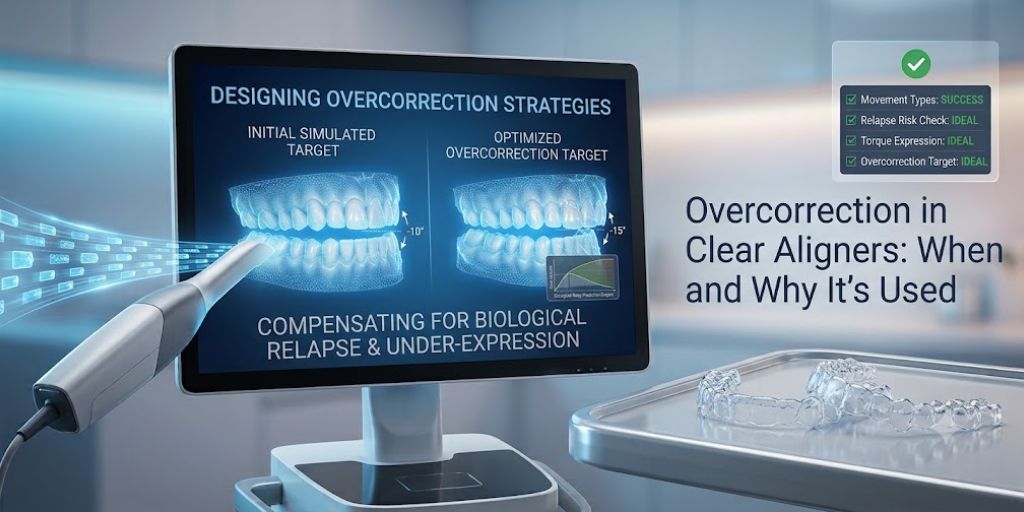
Overcorrection is one of the most important but least understood strategies in clear aligner treatment planning. It refers to intentionally moving teeth slightly beyond their final desired position in order to compensate for biological relapse, material elasticity, and predictable under-expression of certain movements.
In digital orthodontics, where treatment is pre-planned in stages, overcorrection is not an error. It is a deliberate design decision that improves long-term stability and accuracy.
Without it, even well-planned cases can fall short of the intended final occlusion.
Why Overcorrection Exists in Aligners
Clear aligners operate within physical and biological constraints. Unlike fixed appliances that continuously apply force, aligners work in discrete stages with limited force duration.
This introduces a predictable problem: teeth often do not move exactly as simulated. Several factors contribute to this discrepancy:
- Biological response variability means that different patients respond differently to identical force levels. Bone density, periodontal health, and age all influence movement efficiency.
- Material elasticity also plays a role. Thermoplastic aligners deform slightly under pressure, reducing the exact force transmission planned digitally.
- Finally, certain tooth movements, especially rotations and torque, are naturally under-expressed in aligner systems.
Overcorrection compensates for these limitations.
Types of Overcorrection in Orthodontic Planning
Overcorrection is not a single technique. It varies depending on the movement type and clinical objective.
- One of the most common forms is positional overcorrection, where teeth are moved slightly beyond their final alignment target. This is often used in rotational corrections where relapse is highly predictable.
- Another form is bite overcorrection, particularly in deep bite or open bite cases. Here, vertical relationships are adjusted beyond the final desired occlusion to ensure long-term stability.
- There is also torque overcorrection, which is used in cases where root movement tends to lag behind crown movement.
Each type requires different planning logic within the digital system.
When Overcorrection Should Be Applied
Overcorrection is not used in every case. It is applied selectively based on movement complexity and relapse risk.
- Cases involving rotations of rounded teeth, such as canines or premolars, often require overcorrection due to their tendency to rebound after aligner removal.
- Similarly, deep bite corrections frequently require vertical overcorrection to prevent post-treatment settling from reversing results.
- Crowded cases with significant arch expansion may also benefit from controlled overcorrection to maintain space stability.
However, overcorrection must be carefully balanced. Excessive use can lead to patient discomfort or inefficient staging.
How Overcorrection Is Designed in Digital Planning
In 3D orthodontic systems, overcorrection is implemented during staging simulation. The software does not simply move teeth to their final position; it calculates a slightly exaggerated endpoint based on expected biological response.
This requires clinical input combined with predictive modeling.
Planning teams typically adjust:
- Final tooth position targets
- Stage-by-stage movement intensity
- Force distribution across aligners
- Retention compensation factors
The goal is not to overshoot arbitrarily, but to anticipate real-world underperformance.
Risks of Poorly Designed Overcorrection
When overcorrection is misused, it can introduce new problems rather than solve existing ones.
Excessive overcorrection may lead to occlusal interference during treatment, where teeth temporarily collide in unintended ways. This can reduce patient comfort and compliance.
It can also increase the number of aligner stages unnecessarily, extending treatment time without clinical benefit.
In some cases, aggressive overcorrection leads to refinement cycles that could have been avoided with more conservative planning.
Clinical Balance Between Accuracy and Compensation
The most effective overcorrection strategies are subtle rather than aggressive. The goal is not to force movement beyond biological capacity, but to anticipate minor deviations and compensate for them.
Experienced orthodontic planners often rely on historical case data to determine how much overcorrection is appropriate for specific movement types.
This creates a balance between precision and adaptability, ensuring that treatment remains both efficient and predictable.
Conclusion
Overcorrection is a critical safeguard in clear aligner treatment planning. It bridges the gap between digital simulation and biological reality. When used correctly, it improves stability, reduces relapse risk, and enhances final occlusal accuracy. When used incorrectly, it can introduce inefficiency and discomfort.
In modern orthodontics, overcorrection is not optional—it is a strategic necessity grounded in real-world biomechanics.