
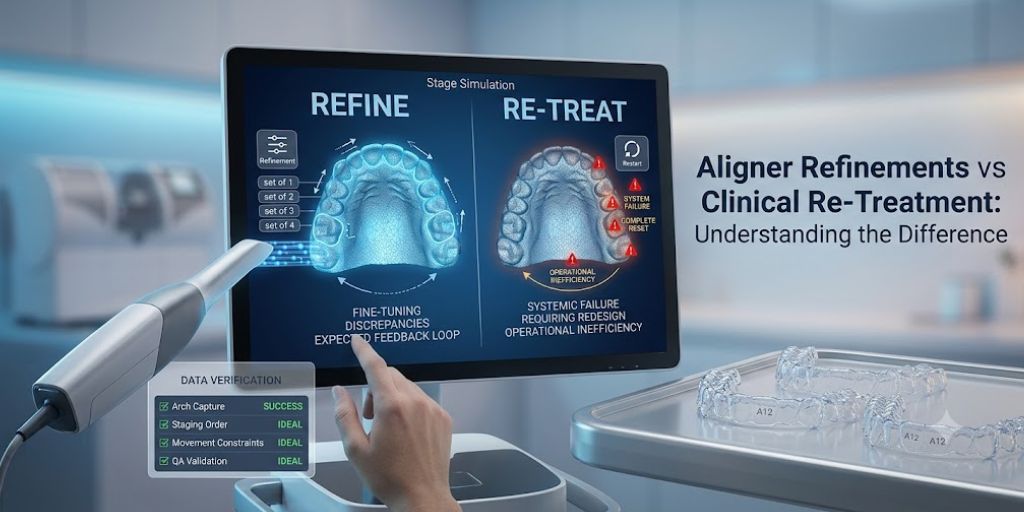
In clear aligner therapy, not all post-treatment adjustments are equal. Two terms are often used interchangeably, refinements and re-treatment, but they represent fundamentally different clinical situations.
Understanding the distinction is critical for both orthodontic planning teams and clinics because it directly affects workflow efficiency, patient communication, and long-term treatment predictability.
Refinements are expected and controlled. Re-treatments indicate a breakdown in initial planning or execution.
What Are Refinements?
Refinements are additional aligner stages designed to fine-tune tooth movement after the initial treatment plan.
They are not failures—they are part of a dynamic feedback system in orthodontics. Even the most advanced 3D planning systems cannot perfectly predict biological response, which is why refinements exist.
Refinements typically address:
- Minor misalignments
- Small rotational discrepancies
- Bite finishing adjustments
- Space closure fine-tuning
In most well-planned cases, refinements are small in scope and limited in duration.
What Is Clinical Re-Treatment?
Re-treatment, on the other hand, is a full or partial restart of orthodontic therapy. It occurs when the original treatment plan fails to achieve its core objectives.
This is not a continuation—it is a reset.
Re-treatment may involve:
- Complete re-scanning of dentition
- New treatment planning from scratch
- Significant changes to movement strategy
- Revised clinical objectives
Unlike refinements, re-treatment indicates that the original system failed to deliver predictable outcomes.
Key Differences Between Refinement and Re-Treatment
While both involve additional aligners, their intent and scale are very different.
Refinements are typically small adjustments within the same treatment framework. They maintain continuity with the original plan and aim to correct minor deviations.
Re-treatments are structural changes that redefine the entire treatment pathway.
The difference is not just clinical—it is also operational. Refinements are expected and built into planning systems, while re-treatments require full re-evaluation.
Why Refinements Happen
Even with precise digital planning, several factors make refinements necessary.
Biological variability is one of the most significant contributors. Teeth do not always move exactly as simulated due to differences in bone density and periodontal response.
Another factor is aligner seating accuracy. If aligners are not fully seated, force delivery becomes inconsistent, leading to incomplete movement.
Small scanning inaccuracies or attachment positioning deviations can also accumulate over time, requiring minor corrections.
Why Re-Treatments Occur
Re-treatment is more complex and usually results from systemic issues rather than isolated errors.
One common cause is inaccurate initial diagnosis or treatment objectives. If the desired outcome was not clearly defined, the entire plan may need restructuring.
Severe compliance issues can also lead to re-treatment. If aligners are not worn consistently, planned forces cannot achieve intended movement.
In some cases, poor initial data quality—especially STL distortion—can compromise the entire treatment simulation from the beginning.
Operational Impact on Clinics
Refinements are manageable within standard workflows. They are anticipated in planning timelines and do not significantly disrupt scheduling.
Re-treatments, however, introduce major operational inefficiencies. They require:
- Re-scanning of the patient
- Re-evaluation of treatment goals
- Additional planning cycles
- Extended chair time
This increases both cost and treatment duration.
How to Reduce Refinements
Reducing refinements begins with improving the accuracy of initial planning.
High-quality STL scans ensure that segmentation and staging are reliable. Clear clinical instructions reduce ambiguity in treatment design.
Proper attachment placement and biologically realistic staging also play a major role in minimizing mid-course corrections.
Ultimately, refinement reduction is a planning discipline, not a post-treatment correction strategy.
How to Avoid Re-Treatment
Re-treatment prevention requires a more comprehensive approach.
Accurate diagnosis at the beginning of treatment is essential. Clinicians must define realistic and achievable objectives based on biological limitations.
Patient education is equally important. Compliance directly affects treatment outcomes, and patients must understand the importance of aligner wear time.
Finally, standardized digital workflows reduce variability and ensure consistency across cases.
Conclusion
Refinements and re-treatments are not interchangeable concepts in orthodontic practice.
Refinements represent fine-tuning within a controlled system. Re-treatments represent systemic failure requiring redesign.
Understanding this distinction allows clinics to improve efficiency, reduce unnecessary costs, and enhance treatment predictability.