Artificial intelligence is increasingly being integrated into orthodontic treatment planning systems, particularly in clear aligner workflows. Its role is to assist in predicting tooth movement, optimizing staging, and improving efficiency in digital planning environments.
Despite rapid adoption, AI in orthodontics is still evolving and has both strengths and limitations that must be clearly understood.
What CAD/CAM Means in How AI Is Used in Orthodontics Today
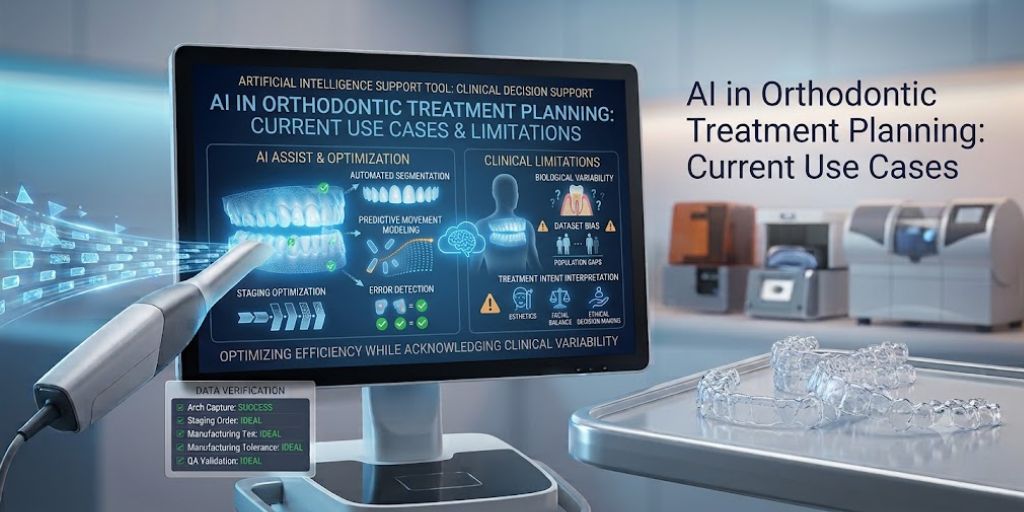
AI is primarily used as a decision-support tool rather than a fully autonomous planning system.
Its most common applications include:
- Automated tooth segmentation in STL files
- Prediction of tooth movement based on historical datasets
- Suggestion of optimal staging strategies
- Detection of scanning errors or inconsistencies
These functions help reduce manual workload and improve consistency in planning.
AI in Tooth Movement Prediction
One of the most promising applications of AI is in predicting how teeth will respond to orthodontic forces.
By analyzing large datasets of previous cases, AI systems can identify patterns in:
- Rotational response
- Intrusion and extrusion behavior
- Arch expansion stability
- Relapse tendencies
This allows planners to create more accurate staging sequences.
AI-Assisted Treatment Planning
Some advanced systems use AI to propose initial treatment plans based on input STL data. These systems can generate:
- Suggested tooth movement paths
- Preliminary staging sequences
- Attachment placement recommendations
However, these outputs are typically reviewed and adjusted by orthodontic professionals before final approval.
Limitations of AI in Orthodontics
Despite its capabilities, AI is not yet capable of fully replacing human clinical judgment.
One major limitation is biological variability. Human teeth do not always respond consistently, and AI systems cannot fully account for individual biological differences.
Another limitation is dataset bias. AI models are trained on historical cases, which may not represent all patient populations or complex malocclusions.
Additionally, AI struggles with treatment intent interpretation. Clinical goals such as aesthetics, facial balance, and functional occlusion require human decision-making.
AI vs Clinical Expertise
AI should be viewed as a support system rather than a replacement for orthodontic expertise.
While AI can optimize efficiency and identify patterns, clinicians are still responsible for:
- Treatment planning decisions
- Ethical considerations
- Patient-specific customization
- Long-term outcome evaluation
The best results are achieved when AI and human expertise are combined.
Impact on Workflow Efficiency
AI significantly improves workflow efficiency in digital orthodontics by reducing time spent on repetitive tasks.
It accelerates:
- Case segmentation
- Initial staging suggestions
- Error detection in scans
- Data preprocessing for planning systems
This allows clinicians to focus more on clinical decision-making rather than manual data handling.
Future of AI in Orthodontics
The future of AI in orthodontics is likely to involve deeper integration into planning systems, including:
- Real-time treatment simulation adjustments
- Predictive relapse modeling
- Fully automated case preprocessing pipelines
- AI-guided refinement reduction systems
However, full autonomy remains unlikely in the near term due to clinical complexity.
Conclusion
AI is reshaping orthodontic treatment planning by improving efficiency, consistency, and predictive capability.
However, it remains a support tool rather than a replacement for clinical expertise.
In modern orthodontics, the most effective systems combine AI-driven insights with human clinical judgment to achieve optimal outcomes.