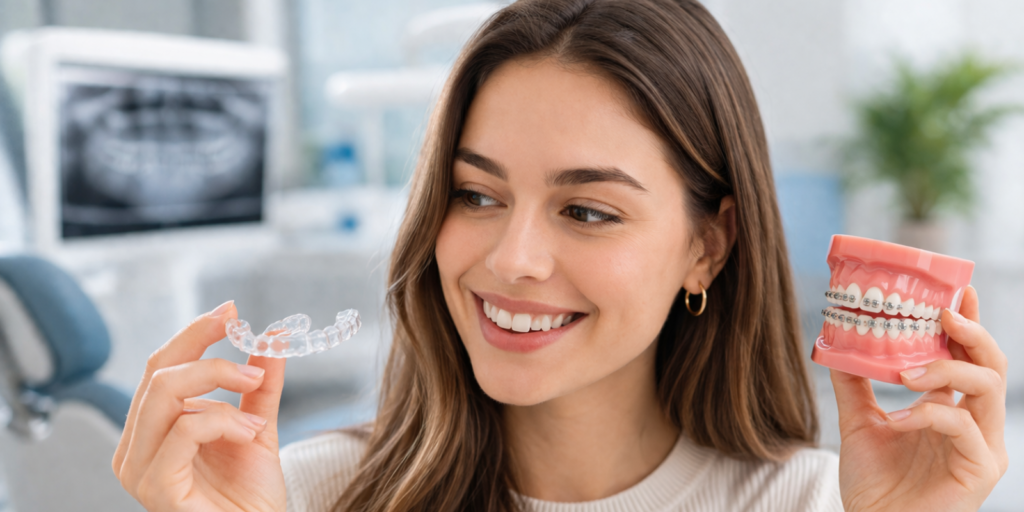
If you have been thinking about straightening your teeth, you have probably already come across this question. Clear aligners or traditional braces? Both work. Both move your teeth. But they do it differently, they feel different, and honestly, they suit different kinds of people. So instead of giving you a generic answer, let us actually talk through this together so you can figure out what makes sense for your life, your smile, and your comfort level.
Maintain a healthy smile by brushing and flossing daily, visiting the dentist regularly, eating a balanced diet, avoiding sugary foods, staying hydrated, and using mouthwash for added protection.
The Core Difference: How Each One Works
Traditional braces use metal brackets that are bonded directly onto your teeth, connected by wires that your orthodontist tightens at each visit. That tension is what moves your teeth over time. They are fixed, meaning they stay on 24 hours a day until your treatment is complete. You do not take them off to eat, you do not take them off to sleep. They are just there, doing their job.
Clear aligners take a completely different approach. You get a series of custom made plastic trays that fit over your teeth and are swapped out every one to two weeks. Each new tray moves your teeth a little further along the planned path. You wear them for 20 to 22 hours a day and remove them when you eat or brush.
According to the American Association of Orthodontists, approximately 4 million people in the United States are currently undergoing orthodontic treatment, with clear aligner usage having grown by over 300% in the last decade.Both approaches are clinically proven. The real question is which one fits your situation better.
Where Clear Aligners Have the Edge
Let us be straightforward with you here. For most adults and older teenagers dealing with mild to moderate alignment issues, clear aligners are genuinely hard to beat.
The comfort alone is a major factor. There are no wires poking the inside of your cheeks, no brackets rubbing against your lips, and no emergency visits because something snapped. The trays are smooth, they fit closely, and most people adapt to them within a few days.
Then there is the visibility factor. A large part of why adults choose clear aligners comes down to the fact that most people around them will never even notice they are in treatment. That matters, especially if you are in a professional environment or simply do not want your orthodontic journey to be the first thing people see when you smile.
A study published in the Angle Orthodontist found that adult patients rated clear aligners significantly higher than braces in terms of aesthetics, comfort, and overall quality of life during treatment. (https://meridian.allenpress.com/angle-orthodontist)
You can also eat whatever you want. No restrictions on popcorn, apples, sticky candy or anything else. You just take your aligners out, eat normally, brush your teeth, and put them back in. Are you leaning toward aligners but still not sure if your case qualifies? Reach out to The Smile Correct and we will walk you through it, no commitment needed.
Where Traditional Braces Still Hold Their Ground
Here is where we want to be genuinely honest with you, because this is not a one sided conversation.
For more complex orthodontic cases, traditional braces still offer a level of precision and control that is difficult to match. Severe crowding, significant bite corrections, large gaps, and cases involving jaw repositioning often respond better to fixed appliances because the orthodontist has more direct control over the forces being applied at every single visit.
Braces are also non-negotiable in terms of compliance. Because they are fixed to your teeth, the treatment works regardless of whether you remember to put something back in. For younger patients especially, consistency matters a lot.
Research published in the Journal of Orthodontics found that traditional braces outperformed clear aligners in cases involving complex tooth movements, particularly significant molar corrections and large vertical changes. (https://journals.sagepub.com/home/jor)
So if your case falls into the more complex category, your orthodontist may genuinely recommend braces, not because aligners are inferior but because your specific situation calls for more precise mechanical control. Not sure how complex your case is? That is exactly what an orthodontic assessment is for. Book yours with The Smile Correct today and get a clear picture of where you stand.
So Which One Is Actually Right for You?
Here is the honest answer. There is no universal winner. It comes down to three things: the complexity of your case, your lifestyle, and your personal priorities.
If you are an adult or older teen with mild to moderate alignment concerns, you value discretion, comfort, and flexibility, and you know you will wear your trays consistently, clear aligners are very likely going to be your best option.
If you have a more complex bite issue, you are a younger patient who might struggle with compliance, or your orthodontist has flagged specific movements that require tighter control, traditional braces may serve you better in the long run.
A systematic review published in the European Journal of Orthodontics concluded that both treatment modalities produce successful outcomes when matched appropriately to case complexity, with patient compliance being the single biggest variable in aligner treatment success.
The best thing you can do right now is stop guessing and get a proper assessment from a qualified team. That one conversation will tell you more than any article can.
At The Smile Correct, we offer precise, affordable orthodontic treatment planning built around your specific case. Whether you are a patient figuring out your options or an orthodontist looking for expert 3D planning support, we are here to help you move forward with confidence.