
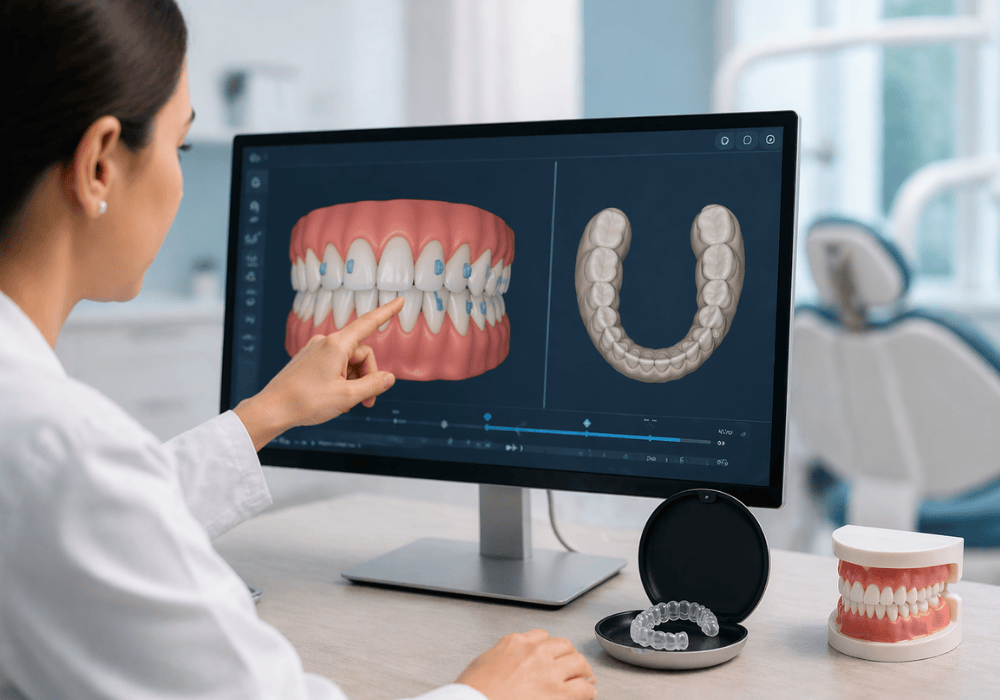
When people hear “3D orthodontic treatment planning,” they often think of advanced software, digital scans, or a more modern-looking workflow. What they usually do not see is the real-world impact that better planning has on treatment experience. In practice, strong 3D planning does not just make a case look cleaner on a screen. It helps reduce unnecessary appointments, shortens the time spent in the chair, improves communication, and makes patients more confident about moving forward with treatment.
That matters because most patients do not reject treatment simply because they dislike the idea of aligners or braces. They hesitate because they are uncertain. They are unsure how long treatment will take, whether the plan is truly personalized, what the final result may look like, and whether the investment will be worth it. A weak planning process creates more confusion around those questions. A strong one answers them early.
Maintain a healthy smile by brushing and flossing daily, visiting the dentist regularly, eating a balanced diet, avoiding sugary foods, staying hydrated, and using mouthwash for added protection.
Why planning quality matters more than most people realize
Orthodontic treatment is not just about moving teeth from one position to another. It involves managing bite relationships, spacing, crowding, rotation, gum health, and function over time. If those factors are not carefully mapped out from the beginning, treatment often becomes more reactive than proactive.
That is where 3D planning changes things. Instead of relying mainly on rough estimates, physical impressions, or broad treatment assumptions, digital planning gives clinicians a more detailed view of the case before treatment begins. The doctor can evaluate tooth position, staging, likely areas of resistance, and how different movements may affect the bite as treatment progresses.
This leads to one major benefit: fewer surprises.
When fewer surprises show up during treatment, appointments become simpler, more focused, and more efficient. Patients spend less time dealing with avoidable delays, and clinicians spend less time correcting issues that should have been anticipated earlier.
Better planning often means fewer and shorter appointments
One of the clearest benefits of 3D orthodontic planning is reduced chair time. That does not mean treatment becomes rushed. It means treatment becomes more organized.
In a well-planned case, each appointment has a clearer purpose. The clinician is not spending extra time trying to figure out why a movement is not tracking, why a bite is shifting unexpectedly, or why the patient’s progress does not match the original expectation. Those problems are not always avoidable, but better planning can reduce how often they happen.
For patients, this creates a smoother experience. Review visits are usually more straightforward, discussions are clearer, and fewer mid-course corrections are needed. For practices, it means better efficiency without sacrificing quality.
In aligner treatment especially, this matters a great deal. Patients usually expect convenience. If a case starts requiring too many unexpected reviews, extra aligners, or repeated explanations, confidence begins to drop. A more accurate digital setup helps keep treatment moving with fewer interruptions.
That is one reason professional 3D treatment planning creates a better overall experience than treatment built around guesswork or minimal oversight.
It improves communication from day one
A large part of treatment acceptance comes down to how well the plan is explained. Many patients hear technical words during consultations without fully understanding what those terms mean for their own case. When that happens, they may nod politely, go home, and delay the decision.
3D treatment planning helps reduce that problem because it makes the case easier to explain visually. A patient can see where the crowding is, how the bite fits together, and what the proposed movement is meant to achieve. That visual clarity often turns an abstract explanation into something more concrete and believable.
This is not a minor benefit. Patients are far more likely to accept treatment when they understand:
- What problem is being corrected
- How the treatment will work
- What the likely result will be
- Why the proposed plan is more suitable for them than a generic alternative
In other words, better planning does not just help the clinician. It helps the patient make a more informed decision.
Why case acceptance improves when the plan is clearer
The phrase “case acceptance” can sound overly commercial, but at its core, it simply means a patient chooses to begin treatment. And patients usually make that choice when they feel informed, reassured, and confident in the recommendation.
A vague consultation creates hesitation. A clear consultation builds trust.
When patients are shown a more personalized treatment roadmap, the decision feels less like a sales conversation and more like a professional recommendation based on evidence. They can better understand the likely treatment sequence, why certain steps may be needed, and what success should reasonably look like.
This is especially important for adults, who often want more certainty before committing. They may be balancing treatment with work, family, appearance concerns, and cost. They do not want a generic promise. They want a plan that feels thought through.
That is where 3D planning becomes valuable beyond the technical side. It gives patients confidence that the clinician has actually studied their case in detail rather than applying a one-size-fits-all approach.
It also helps manage expectations more honestly
One of the biggest reasons patients become frustrated is not always poor treatment. Sometimes it is poor expectation-setting.
If patients believe their case will be quick and simple when it is actually more involved, disappointment is almost guaranteed. Better digital planning allows clinicians to have more honest conversations from the start. If attachments will be needed, that can be explained clearly. If space creation is necessary, it can be discussed early. If refinements are likely, that can be framed as a normal part of achieving a better finish rather than as a failure.
This matters because realistic expectations protect trust.
Patients generally handle complexity better when it is explained in advance. What they dislike is feeling surprised halfway through treatment. A stronger planning process reduces that risk by making the treatment path easier to map out before the first aligner is even worn.
This is also where it naturally makes sense to reference aligner refinements, especially when explaining that refinements are sometimes part of responsible treatment rather than a sign that something has gone wrong.
Strong planning supports better treatment quality, not just efficiency
Reducing chair time is useful, but it should never become the only goal. The real value of 3D planning is that it helps improve both efficiency and quality at the same time.
A better digital setup allows clinicians to think more carefully about tooth movement, sequencing, and control. Some movements look simple in theory but are harder to achieve in real life. Others may affect the bite in ways that are easy to overlook without a detailed review. By assessing these factors early, treatment can be built with better judgment rather than relying on correction later.
For patients, this means a higher chance of treatment feeling smoother and more predictable. For practices, it means fewer avoidable problems that consume time and reduce confidence.
That combination is what makes 3D planning so valuable. It is not just about looking advanced. It is about working in a way that is more deliberate.
Where this approach makes the biggest difference
Not every case carries the same level of complexity, but 3D planning becomes especially helpful when there are multiple things happening at once. This can include crowding, spacing, bite discrepancies, rotations, or cases where treatment needs to balance cosmetic improvement with functional stability.
In simpler cases, digital planning still helps because it improves communication and consistency. In more involved cases, it becomes even more important because the room for error is smaller.
Patients often assume orthodontic treatment is mainly about straightening front teeth. In reality, the quality of the final result depends on much more than what is visible in the smile line. Better planning helps ensure that treatment decisions are not being made too narrowly.
Final thoughts
3D orthodontic treatment planning reduces chair time because it reduces confusion, avoidable detours, and unnecessary repetition. It increases case acceptance because it helps patients understand the treatment more clearly and trust it more fully.
That is the real takeaway.
People are more likely to move forward with orthodontic care when the process feels organized, personalized, and transparent. They are also more likely to stay confident during treatment when appointments are focused and progress feels purposeful. Better planning supports both outcomes.
Used properly, 3D planning is not just a digital extra. It is a better way to explain treatment, guide treatment, and improve the overall experience for everyone involved.