
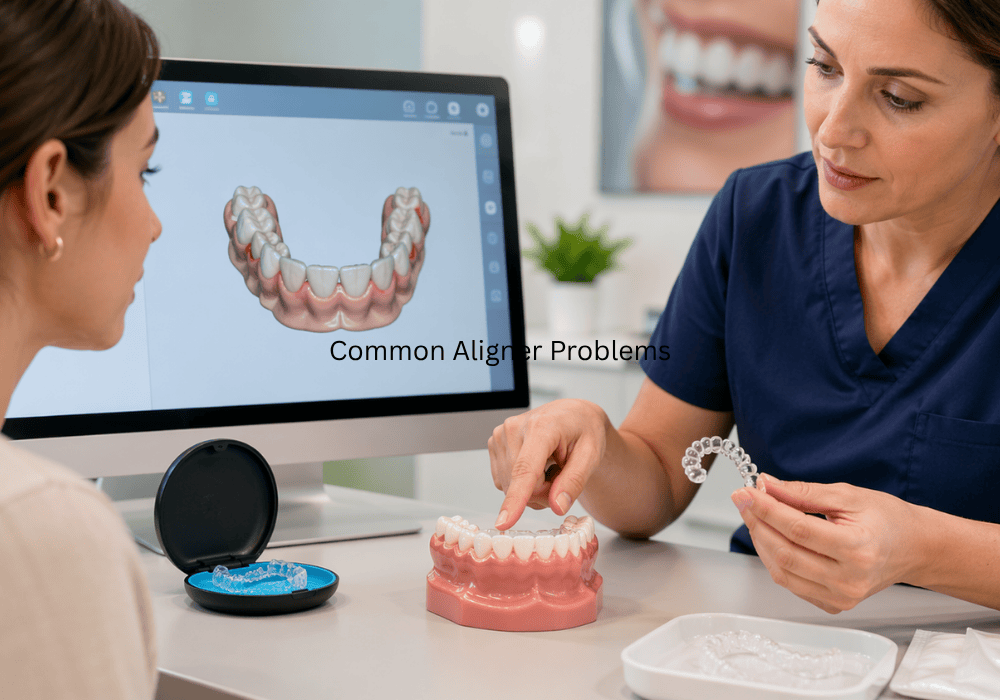
Clear aligners are often presented as simple. Wear the trays, change them on schedule, and wait for your teeth to move. In reality, even well-planned aligner treatment can come with small issues along the way. Some are normal and easy to manage. Others are signs that the case needs attention.
The mistake many patients make is assuming every problem means treatment is failing, or worse, assuming every problem will fix itself if they ignore it. Neither approach is smart. The better approach is to understand which aligner issues are common, what usually causes them, and when they can be handled with simple changes versus when they need professional review.
Most aligner problems are manageable when they are caught early. That is why patient awareness matters so much. A person who knows what to look for usually has a smoother treatment experience than someone who wears trays passively and hopes for the best.
Tightness and pressure when switching trays
This is one of the most common concerns, especially at the beginning of treatment or when moving to a new aligner. Patients often worry that tightness means something is wrong. In many cases, it actually means the aligner is doing what it is supposed to do.
Clear aligners work by applying controlled pressure to guide tooth movement. Some tightness is normal, particularly during the first day or two after changing trays. The sensation is usually described as pressure rather than sharp pain.
What matters is the severity. Mild to moderate pressure is expected. Severe pain, especially if it does not improve after a short period, deserves attention.
A few things usually help:
- switch to a new tray at night so the first several hours happen during sleep
- wear the aligners consistently instead of taking them out too often
- avoid switching trays earlier than advised
If the discomfort feels excessive or continues beyond the normal adjustment period, it may be worth checking whether the tray is seating properly or whether the treatment needs review.
Aligners not fitting properly
A tray that does not fit properly is not something patients should ignore. Sometimes the problem is small, such as a slight gap at first insertion that settles after a few hours of wear. Other times, the aligner clearly is not fully seated on one or more teeth.
Poor fit may happen for several reasons. The most common is inconsistent wear. If aligners have not been worn for the recommended number of hours, the teeth may lag behind the planned movement, and the next tray may feel like it does not belong. In other cases, a specific tooth may not be tracking as expected even if the patient has been compliant.
This issue should be taken seriously because a small fit problem can become a larger tracking problem if the patient keeps moving ahead without addressing it.
Patients should not force the situation by rushing to the next tray or assuming it will sort itself out. Often, the smarter step is to keep wearing the current tray as instructed and contact the provider if the fit does not improve. This is one reason regular monitoring matters so much during treatment.
Speech changes
Many patients notice a temporary change in speech when they first start aligners. Certain sounds may feel awkward, and there may be a slight lisp for a short time. This is usually not a sign of a problem. It is just part of adjusting to having a removable appliance over the teeth.
For most people, speech improves as the tongue adapts. The more consistently the aligners are worn, the faster this adjustment usually happens. Patients who keep removing them because speech feels unfamiliar may actually prolong the adjustment period.
Reading out loud for a few minutes each day can help. So, can being patient instead of overreacting to the first few days. If a speech issue continues far beyond the normal adjustment period, the provider can check whether the fit or attachments are contributing to it.
Soreness from tray edges
Sometimes the issue is not tooth pressure but irritation from the edge of the aligner rubbing against the gums, lips, or tongue. This can make aligners feel harsher than patients expected, even when the tooth movement itself is manageable.
Minor edge irritation is fairly common, especially with a new tray. In some cases, the irritation settles as the mouth adjusts. In other cases, a rough or sharp area may need smoothing.
Patients should not try to make major changes to the tray themselves, but they should mention the issue if it is persistent. A provider can often identify whether the irritation is temporary or whether the tray edge needs attention.
The key is not to confuse irritation with treatment failure. It is often a comfort issue, not a sign that the orthodontic plan is wrong.
Attachments feel strange or seem to come off
Attachments are small tooth-colored shapes placed on certain teeth to help the aligners grip and move them more effectively. Patients often do not think much about attachments until they suddenly feel them or notice one appears to have come off.
It is normal for attachments to feel unfamiliar at first. They can make the aligners harder to remove in the beginning, and they may feel rough to the tongue for a short period. Most patients adapt.
If an attachment actually comes off, the case should be reviewed rather than ignored. Some movements depend heavily on attachments, and losing one can affect how well that tooth tracks.
This is where it naturally makes sense to reference why attachments matter in clear aligner treatment, because patients often underestimate how important these small features are to the overall plan.
Trays smell bad or look cloudy
This is usually not a treatment problem. It is a hygiene problem.
Aligners sit in the mouth for many hours a day, so they need regular cleaning. If they are not cleaned properly, they can develop odor, cloudiness, or buildup that makes them look unpleasant and feel less fresh.
Patients sometimes damage trays by cleaning them the wrong way. Very hot water can warp plastic. Toothpaste can sometimes be too abrasive. A better approach is to follow the provider’s cleaning advice consistently and avoid improvising with harsh methods.
The larger point is that good aligner hygiene is part of good treatment. A patient who neglects tray care often ends up with a worse day-to-day experience, even if the tooth movement itself is progressing well.
Teeth not seeming to move fast enough
Impatience is one of the most common psychological problems in aligner treatment. Patients expect visible change early, and when movement feels slower than expected, they start doubting the process.
This can lead to bad decisions, such as shortening wear time, changing trays too quickly, or second-guessing the provider after only a short period.
Teeth do not all move at the same pace. Some changes become visible early, while others take longer. A case may be progressing properly even if the patient cannot easily see dramatic weekly improvement.
That is why clear aligner treatment timelines should be explained honestly from the start. Treatment is rarely one smooth visual transformation from week to week. It is a staged process, and some stages feel slower than others.
Teeth not tracking properly
Tracking problems are more important than simple impatience. If a tooth is not following the aligner as intended, the mismatch may become visible as a gap between the tray and the tooth or as a movement that stalls despite continued wear.
Tracking issues can happen because of:
- inconsistent wear
- difficult tooth movements
- lost or broken attachments
- a case that needs reassessment
This is one of the clearest examples of why patients should not self-manage everything. Waiting too long can make the later stages less accurate and increase the chance of extra correction being needed.
Sometimes, small tracking issues can be managed early. Sometimes they lead to an updated plan or extra trays later. That is exactly why aligner refinements are a normal part of some cases rather than something patients should automatically fear.
Losing or breaking an aligner
This happens more often than patients expect. A tray gets wrapped in a napkin at lunch, thrown away by accident, cracked during removal, or left somewhere unsafe.
When this happens, patients should not guess their way through the next step. Moving ahead too soon or going without an aligner for too long can affect progress. The safest response is usually to contact the provider for instructions rather than trying to make an independent decision.
This may sound obvious, but many treatment delays happen because patients assume one missing tray is not a big deal. Sometimes it is manageable. Sometimes it disrupts the whole sequence.
Biting feels different
A changing bite can be unsettling. Patients may feel that certain teeth touch first, that chewing feels unusual, or that the bite is shifting during treatment. Some of this can be part of normal progression, especially as teeth move into new positions.
Still, bite changes should not be dismissed automatically. Orthodontic treatment affects more than front-tooth appearance. If the bite feels increasingly off, or if chewing becomes significantly uncomfortable, the provider should assess it.
Patients often focus on straightness, but function matters just as much. A smile that looks improved but does not feel balanced is not a strong result.
When should a patient contact the provider?
Some issues are normal and temporary. Others deserve a timely review. Patients should usually get in touch if:
- an aligner will not seat properly after reasonable wear
- pain feels excessive or unusual
- an attachment breaks or comes off
- the bite feels increasingly unstable
- a tray is lost or cracked
- there are visible tracking problems that are not improving
The goal is not to panic over every small discomfort. The goal is to avoid the opposite mistake of ignoring signs that treatment needs attention.
Final thoughts
Most aligner problems are not disasters. They are part of a treatment process that depends on biology, consistency, and good communication. The real danger is not that problems appear. The real danger is that patients either overreact or ignore them completely.
A better mindset is simple: expect a few bumps, pay attention, and address issues early.
Clear aligner treatment usually goes more smoothly when patients understand that success is not just about wearing trays. It is also about recognizing when something is normal, when something needs a simple fix, and when something deserves professional review. That kind of awareness protects both the timeline and the final result.