
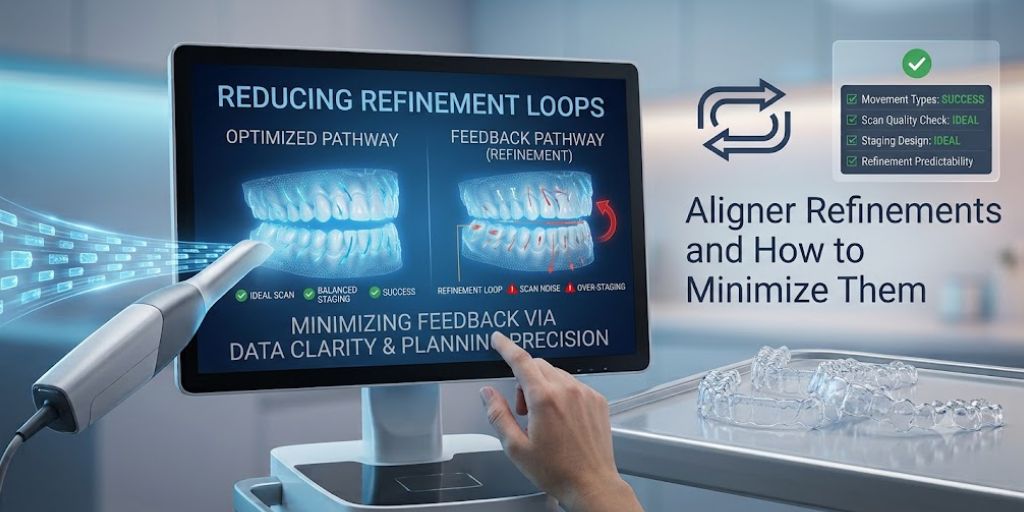
The journey from a digital scan to a finished set of clear aligners is one of the most sophisticated workflows in modern dentistry. It involves multiple stages of digital transformation, biomechanical planning, and precision manufacturing.
Understanding this pipeline is essential for clinics that rely on outsourced planning or high-volume aligner production systems.
Each step in the process builds on the previous one, meaning that small errors early in the workflow can significantly affect the outcome.
Step 1: STL Acquisition and Validation
AThe process begins with intraoral scanning and STL file generation. This digital impression captures the patient’s dentition in three dimensions and serves as the foundation for all subsequent planning.
Before any treatment design begins, the STL file undergoes validation. This includes checking for completeness, surface integrity, and occlusal accuracy.
If the scan is incomplete or distorted, it is returned for correction before planning begins.
Step 2: Digital Segmentation and Model Preparation
Once validated, the STL file is imported into orthodontic planning software, where each tooth is segmented individually.
Segmentation is a critical step because it determines how the software interprets tooth boundaries and movement capabilities.
During this phase, planners ensure that:
- Each tooth is accurately isolated
- Gingival boundaries are clean
- Occlusal surfaces are correctly mapped
Segmentation errors often lead to inaccurate staging later in the process.
Step 3: Treatment Planning and Staging
After segmentation, the actual orthodontic planning begins. This involves determining how each tooth will move over time to achieve the desired occlusion.
The movement is divided into stages, with each stage representing a small incremental adjustment.
This step includes decisions related to:
- Alignment sequence
- Bite correction strategy
- Space creation or closure
- Movement prioritization
The quality of staging directly affects treatment duration and predictability.
Step 4: Attachment Design and Optimization
Attachments are then designed and placed on selected teeth based on movement requirements.
Their purpose is to improve force transmission between the aligner and the tooth surface.
Proper attachment design ensures that planned movements are physically achievable and biomechanically stable.
Step 5: Aligners Manufacturing Preparation
Once the digital plan is finalized, each stage is converted into a physical model. These models represent the progressive positions of the teeth throughout treatment.
Manufacturing preparation includes:
- 3D printing of stage models
- Quality validation of each stage
- Alignment of staging sequence
This ensures that physical production matches digital planning precisely.
Step 6: Thermoforming and Finishing
Aligners are created using thermoforming techniques, where plastic sheets are molded over 3D printed models.
After forming, aligners are trimmed, polished, and labeled according to treatment stage.
Quality control checks ensure consistency in thickness, fit, and edge comfort.
Step 7: Final Quality Assurance and Delivery
Before delivery, aligners undergo a final inspection to ensure that each stage matches the original digital plan.
Any discrepancies are corrected before shipment to the clinic.
This final step ensures that what was digitally designed is faithfully reproduced in physical form.
Importance of Workflow Consistency
The STL-to-manufacturing pipeline is highly sensitive to inconsistencies. Even minor deviations in early stages can accumulate into significant clinical differences later.
Standardization across scanning, planning, and manufacturing ensures predictable outcomes and reduces the need for refinements.
Final Thoughts
The transformation from STL scan to finished aligners is a multi-stage precision workflow that combines digital dentistry, biomechanical planning, and manufacturing engineering.
Each stage depends on the accuracy of the previous one, making consistency and quality control essential.
In modern orthodontics, success is not determined by a single step; it is determined by the integrity of the entire pipeline.