
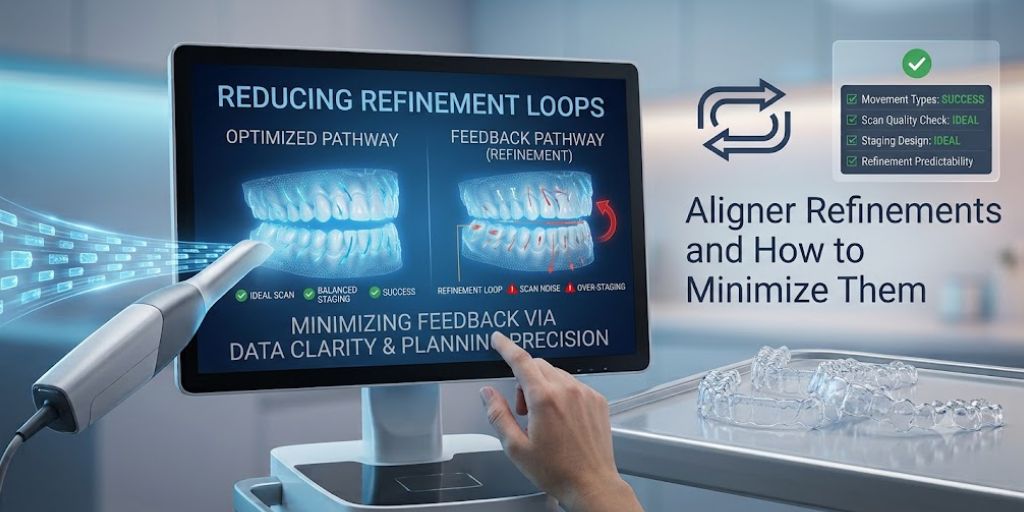
Refinements are a natural part of clear aligner therapy, but they are often misunderstood as a failure of treatment planning. In reality, refinements are a feedback mechanism that corrects differences between digital predictions and biological responses.
However, frequent or excessive refinements indicate inefficiencies in either case planning, scanning quality, or sequencing strategy.
Reducing refinements is one of the most effective ways to improve clinical efficiency, patient satisfaction, and overall treatment predictability.
What Are Refinements in Clear Aligner Treatment?
A refinement refers to an additional set of aligners created after the initial treatment plan to adjust tooth movement.
These adjustments are typically made when:
- Teeth do not fully reach planned positions
- Bite relationships require correction
- Minor rotations or spacing remain unresolved
Refinements essentially recalibrate the treatment based on real-world response.
Why Refinements Are Needed
Even with advanced 3D planning systems, orthodontic treatment is not purely deterministic. Biological systems introduce variability that cannot always be predicted digitally.
One of the most common causes is incomplete tooth movement during the initial stages. Teeth may lag behind planned trajectories due to bone density differences or inconsistent force application.
Another factor is aligner seating issues. If aligners are not fully seated, intended forces are not applied correctly, leading to incomplete movement.
Small errors in STL scanning or attachment placement can also accumulate over time, creating deviations that require correction.
Types of Refinements
Refinements can generally be categorized into three types.
Minor refinements involve small adjustments, often aesthetic in nature, such as slight rotations or spacing corrections. These are common and usually expected.
Moderate refinements address functional issues like bite alignment or midline correction.
Major refinements are less common and typically indicate significant discrepancies between planned and actual movement.
Understanding the type of refinement helps identify whether the issue is clinical, technical, or workflow-related.
How Planning Quality Affects Refinement Rates
The quality of initial treatment planning is the most important factor in determining refinement frequency.
Accurate STL files reduce early-stage errors. Proper segmentation ensures that tooth boundaries are correctly interpreted.
Well-designed staging reduces biological overload, improving movement predictability. Attachment placement also plays a major role in ensuring force is applied effectively.
When these factors are optimized, refinement rates decrease significantly.
Common Causes of Excessive Refinements
One of the most frequent causes is poor initial scanning quality. Distorted or incomplete STL files lead to inaccurate simulation models.
Another major factor is overly aggressive staging. When teeth are moved too quickly between aligners, biological response cannot keep up with the digital plan.
Patient compliance also plays a role. Inconsistent aligner wear reduces force application, leading to incomplete movement.
Finally, unclear treatment objectives at the planning stage often result in misaligned expectations between clinician and planner.
Strategies to Minimize Refinements
Reducing refinements requires a systematic approach rather than isolated fixes.
Standardizing scan quality ensures that planning begins with accurate data. This alone eliminates a large portion of preventable errors.
Improving staging design by using biologically realistic movement increments reduces stress on teeth and increases predictability.
Clear communication of clinical goals ensures that planning decisions align with real-world expectations.
Together, these strategies significantly reduce the need for post-treatment corrections.
Role of Outsourced Planning in Refinement Reduction
In outsourced orthodontic planning systems, refinement rates are often influenced by intake quality and standardization protocols.
Structured submission systems allow planning teams to work with consistent data formats, reducing variability in outcomes.
Fast-turnaround models, such as 8-hour planning systems, rely heavily on clean inputs to avoid iterative correction cycles.
Conclusion
Refinements are an expected part of clear aligner treatment, but they should not dominate the workflow.
When planning, scanning, and staging are optimized, refinements become minimal and predictable rather than frequent and corrective.
In modern orthodontics, the goal is not to eliminate refinements, but to reduce them to controlled, minor adjustments that preserve efficiency and clinical precision.