
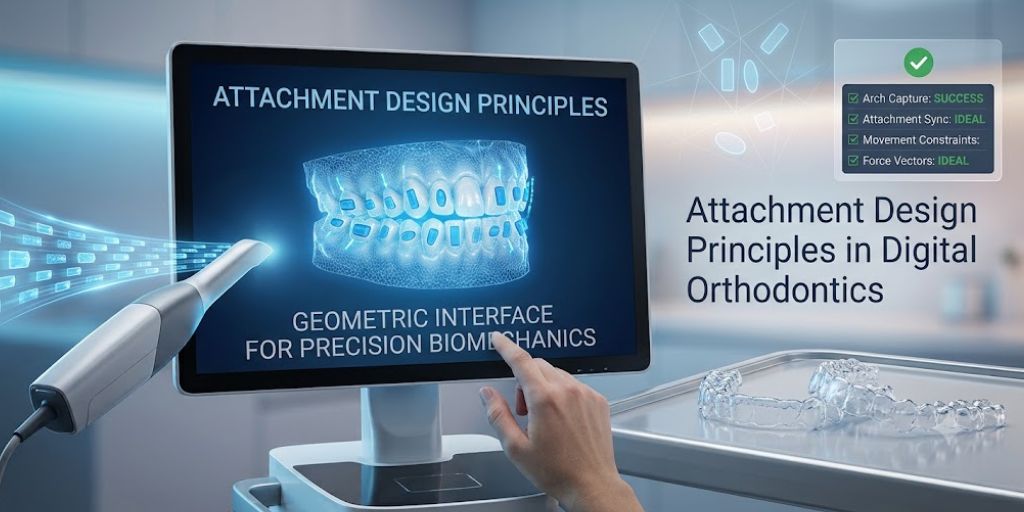
Attachments are one of the most misunderstood yet essential components of clear aligner therapy. While they appear as small composite shapes on tooth surfaces, their role in orthodontic biomechanics is significant.
In digital treatment planning, attachment design determines how effectively aligner forces are transmitted to teeth. Without properly designed attachments, even the most advanced staging plan can fail to achieve its intended movement.
What Attachments Do in Clear Aligner Therapy
Attachments act as mechanical interfaces between the aligner material and the tooth surface. They enhance grip, improve force direction, and enable movements that would otherwise be inefficient or impossible.
Without attachments, aligners rely solely on surface contact, which limits their ability to perform complex movements such as root torque or controlled extrusion.
Attachments effectively convert passive aligners into active force delivery systems.
Design Principles Behind Attachments
Attachment design is not arbitrary. Each shape, size, and orientation is chosen based on the specific movement required at a given stage.
Rectangular attachments are commonly used for rotational control because they provide directional resistance. Elliptical or optimized shapes may be used for aesthetic regions where visibility is a concern.
The placement of attachments is equally important. Even a small positional error can alter force vectors, reducing efficiency or introducing unintended movements.
Timing and Activation in Treatment Sequencing
Attachments are not always active from the beginning of treatment. In many cases, they are introduced at specific stages depending on sequencing requirements.
This staged activation ensures that forces are applied only when necessary, reducing unnecessary stress on teeth in early treatment phases.
The synchronization between attachment placement and aligner stage design is critical for predictable outcomes.
Common Attachment Design Errors
One of the most common errors is overuse of attachments. While attachments improve control, excessive placement can create hygiene challenges and patient discomfort.
Another issue is incorrect orientation. If an attachment is rotated even slightly, force direction can be altered significantly, reducing treatment efficiency.
Size mismatch is also problematic. Attachments that are too small may fail to engage the aligner properly, while oversized attachments can cause seating issues.
Clinical Impact of Proper Attachment Design
Well-designed attachments improve:
- Rotational control
- Extrusion accuracy
- Torque expression
- Overall treatment predictability
They also reduce the need for refinements by ensuring that planned forces are effectively transmitted during each stage.
Relationship Between Attachments and Digital Planning Systems
In modern 3D orthodontic workflows, attachments are not manually added in isolation. They are integrated into the treatment plan itself.
Planning software calculates optimal placement based on tooth geometry, movement direction, and force requirements. This ensures consistency between digital design and clinical execution.
Final Thoughts
Attachments are small in size but critical in function. They bridge the gap between digital planning and physical tooth movement.
Effective attachment design ensures that clear aligners perform as intended, reducing refinements and improving clinical predictability.
In modern orthodontics, attachments are not optional enhancements, they are essential biomechanical tools.