
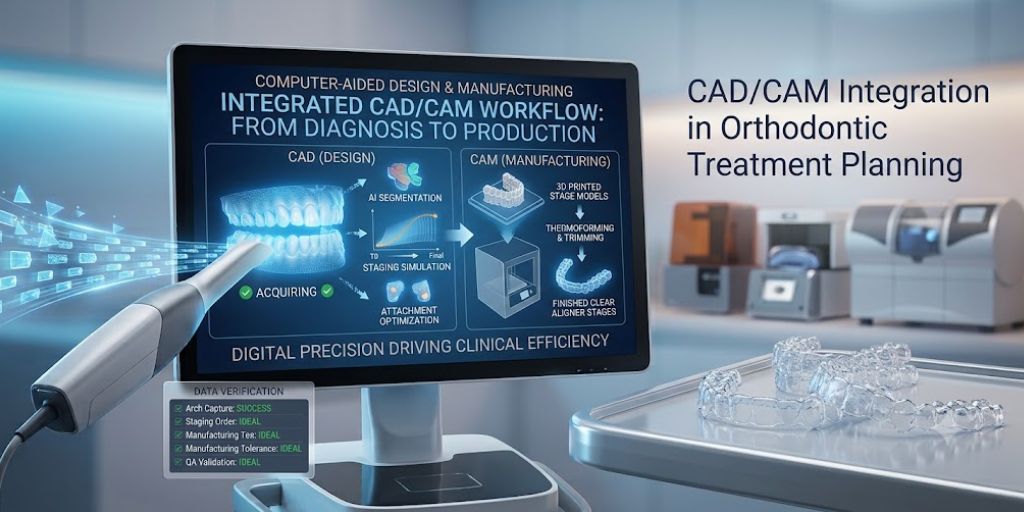
Computer-Aided Design and Computer-Aided Manufacturing (CAD/CAM) has fundamentally transformed orthodontic treatment planning. What was once a manual and highly variable process is now a digitally controlled system capable of producing highly predictable outcomes.
Both strategies are used in digital orthodontic planning, but they serve different purposes. Overcorrection compensates for predictable biological shortfalls, while undercorrection may be used to avoid overloading teeth or soft tissue structures.
In clear aligner therapy, CAD/CAM integration connects diagnosis, planning, and manufacturing into a continuous digital workflow.
What CAD/CAM Means in Orthodontics
CAD/CAM refers to a digital workflow where:
- CAD (Computer-Aided Design) is used for treatment planning
- CAM (Computer-Aided Manufacturing) is used for producing physical aligners
In orthodontics, CAD systems design tooth movements, while CAM systems convert those designs into physical aligners through 3D printing and thermoforming.
This eliminates traditional impression-based variability and allows for highly standardized production.
Role of CAD in Treatment Planning
The CAD stage is where orthodontic intelligence is applied. Using STL files, clinicians or planning teams simulate tooth movement in a virtual environment.
This includes:
- Tooth segmentation
- Occlusion modeling
- Movement staging
- Attachment design
- Final alignment simulation
The CAD system allows planners to visualize treatment outcomes before any physical manufacturing begins.
This predictive capability is what makes modern aligner systems so powerful.
CAM: From Digital Plan to Physical Aligners
Once the CAD design is finalized, the CAM process takes over. This is where digital models are converted into physical aligners.
The process typically involves:
- 3D printing of staged dental models
- Thermoforming plastic sheets over each model
- Trimming and polishing aligners
- Quality verification of each stage
CAM ensures that every aligner corresponds exactly to its digital counterpart.
Why CAD/CAM Integration Improves Accuracy
Before CAD/CAM systems, orthodontic appliances were often manually fabricated, introducing variability at every step.
Digital integration eliminates this variability by:
- Standardizing production workflows
- Reducing human error
- Ensuring repeatability across cases
- Improving alignment between planning and manufacturing
This leads to significantly improved treatment predictability.
Impact on Clinical Efficiency
One of the most significant advantages of CAD/CAM integration is efficiency.
Clinics benefit from:
- Faster treatment planning cycles
- Reduced chairside adjustments
- Fewer refinements
- Improved patient throughput
By reducing manual steps, clinicians can focus more on diagnosis and patient care rather than fabrication logistics.
Challenges in CAD/CAM Workflows
Despite its advantages, CAD/CAM integration is not without challenges.
One major issue is data dependency. If STL files are inaccurate, CAD planning becomes unreliable, and CAM production simply replicates those errors.
Another challenge is software compatibility. Different systems may interpret digital models differently, leading to minor discrepancies in output.
Finally, manufacturing calibration is critical. Even small deviations in thermoforming temperature or material thickness can affect the final aligner fit.
Future of CAD/CAM in Orthodontics
The future of CAD/CAM in orthodontics is moving toward full automation.
Emerging trends include:
- AI-assisted treatment planning
- Fully automated staging algorithms
- Direct-to-aligner 3D printing
- Cloud-based planning systems
These advancements will further reduce manual intervention and improve consistency.
Conclusion
CAD/CAM integration has redefined orthodontic treatment planning by connecting digital design with physical manufacturing.
It has transformed clear aligner therapy into a predictable, scalable, and highly efficient system.
In modern orthodontics, CAD/CAM is not just a tool—it is the infrastructure of treatment delivery.