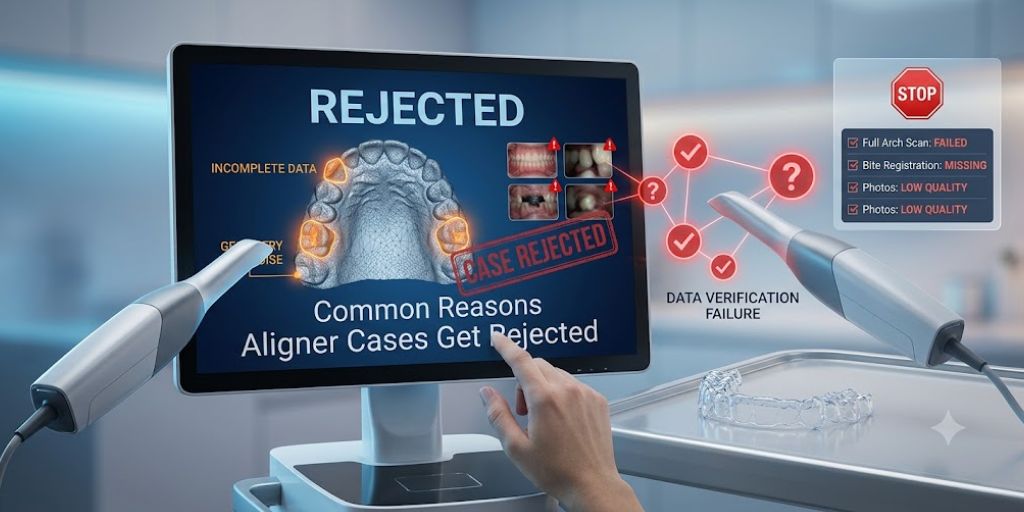
Case rejection in clear aligner workflows is often misunderstood as a clinical limitation. In most cases, however, rejection has nothing to do with whether a case can be treated—it is instead a reflection of insufficient or unclear input data.
Planning teams rely entirely on the quality of submitted information. When that information is incomplete, inconsistent, or ambiguous, rejection becomes a necessary step to protect treatment accuracy.
Understanding Case Rejection in Digital Orthodontics
A rejected case does not indicate treatment failure. Rather, it signals that the current dataset is not adequate for safe or predictable planning.
In digital orthodontics, every decision, staging, attachment design, and force distribution depends on precise modeling. If the input is unreliable, the output cannot be trusted.
This makes rejection less of a setback and more of a quality control mechanism.
Incomplete or Inaccurate STL Files
The most common reason for rejection is incomplete scanning. Missing posterior segments, especially molars, significantly compromise occlusal modeling.
When arches are not fully captured, software must estimate missing anatomy, which reduces accuracy. Even minor gaps can affect alignment, sequencing, and bite correction strategies.
Similarly, distorted STL geometry caused by scanning interruptions or surface noise can make segmentation unreliable.
Missing Occlusal or Bite Data
Without a stable bite registration, it becomes impossible to evaluate how upper and lower arches interact.
This affects critical treatment decisions such as:
- Midline correction feasibility
- Vertical dimension changes
- Crossbite correction planning
When occlusal relationships are unclear, planning teams cannot safely proceed.
Lack of Clinical Direction
Another frequent reason for rejection is the absence of clear treatment objectives. Digital systems require explicit instructions to generate predictable outcomes.
Vague statements such as “improve alignment” do not provide sufficient guidance for structured planning.
Instead, planners require clarity on extraction preferences, aesthetic priorities, and functional goals.
Poor Quality Diagnostic Photography
Photographs are not optional in modern orthodontic planning. They provide contextual information that STL files cannot capture.
Facial symmetry, smile line, and midline positioning all depend on visual assessment. When photographs are missing or unclear, aesthetic planning becomes incomplete.
File Handling and Format Issues
Technical errors also contribute to rejection rates. These include corrupted files, incorrect export formats, or improperly structured data packages.
Even when clinical data is correct, poor file handling can prevent systems from processing the case correctly.
How Rejection Affects Workflow Efficiency
Rejected cases introduce delays that extend beyond simple resubmission. They disrupt planning queues, delay manufacturing schedules, and reduce clinical throughput.
In high-volume practices, even a small rejection rate can significantly impact operational efficiency over time.
Preventing Case Rejection Through Standardization
The most effective prevention strategy is structured submission protocols. Clinics that implement standardized workflows experience significantly lower rejection rates.
This typically involves:
- Pre-submission scanning validation
- Mandatory checklist completion
- Internal case review before submission
- Standardized file formatting rules
Conclusion
Case rejection is not a failure of treatment feasibility—it is a reflection of input quality.
When clinics prioritize structured data collection and standardized submission processes, rejection rates drop significantly, leading to:
- Faster approvals
- More efficient planning cycles
- Reduced administrative burden
- Improved treatment predictability
In digital orthodontics, precision begins before planning—it begins at submission.