
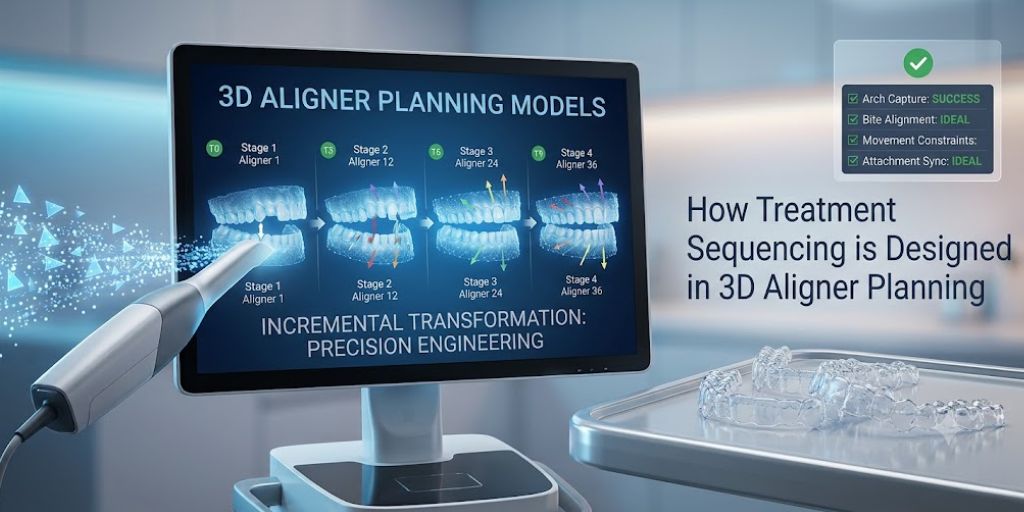
Treatment sequencing is the invisible logic that determines how teeth move from their initial position to the final planned occlusion in clear aligner therapy. While patients see only a series of plastic trays, clinicians understand that each aligner represents a carefully calculated stage of biomechanical transformation.
In 3D orthodontic planning, sequencing is not linear—it is dynamic, predictive, and constrained by biological limits. Understanding how this sequence is designed is essential for achieving predictable outcomes.
What Treatment Sequencing Actually Means
At its core, treatment sequencing refers to the staged progression of tooth movement over time. Instead of moving all teeth simultaneously, orthodontic systems divide movement into controlled increments.
Each stage represents a small adjustment in position, typically measured in fractions of a millimeter. These incremental movements ensure that forces remain within biologically acceptable limits, preventing root damage and maintaining periodontal health.
Sequencing determines not only the direction of movement but also its timing and interaction with adjacent teeth.
How Digital Planning Systems Build Sequencing Models
Modern clear aligner systems use 3D modeling software to simulate tooth movement in a virtual environment. This allows clinicians or planning teams to visualize the entire treatment before manufacturing begins.
The process typically begins with segmentation, where each tooth is digitally isolated. Once segmentation is complete, the system applies movement algorithms based on the desired final occlusion.
However, these movements are not applied simultaneously. Instead, they are distributed across multiple stages to ensure biological feasibility.
Biological Constraints in Sequencing Design
One of the most important factors in sequencing is biological limitation. Teeth cannot move arbitrarily; they respond to controlled forces over time.
Certain movements, such as intrusion or root torque, require slower progression due to periodontal constraints. Rotations in round teeth also require staged correction rather than single-step adjustment.
Sequencing must account for these biological realities, or treatment predictability decreases significantly.
Prioritization of Movements
Not all tooth movements occur at the same stage. Sequencing follows a hierarchy based on clinical priority.
For example, space creation often occurs before alignment. Without sufficient space, crowding cannot be resolved efficiently.
Similarly, major bite corrections are often staged before fine aesthetic alignment, ensuring that functional stability is established first.
This hierarchy ensures that each stage builds on a stable foundation.
Role of Attachments in Sequencing Control
Attachments play a critical role in translating digital plans into physical tooth movement. They act as anchor points that help direct forces more precisely.
In sequencing design, attachment placement is synchronized with movement stages. Certain movements only become effective once attachments are activated in the corresponding aligner stage.
Without proper coordination, even well-designed sequencing can fail clinically.
Predictability Challenges in Sequencing
Despite advanced planning tools, sequencing is not perfectly predictable. Biological variability, patient compliance, and material limitations all influence outcomes.
This is why refinement cycles exist. They allow clinicians to adjust sequencing based on real-world tooth response rather than purely digital prediction.
However, better initial sequencing reduces the need for these corrections.
How Sequencing Impacts Treatment Duration
Treatment duration is directly linked to sequencing efficiency. Overly conservative staging increases total treatment time, while aggressive staging risks biological overload.
The balance between speed and safety is one of the most critical aspects of orthodontic planning.
Well-optimized sequencing reduces unnecessary stages while maintaining clinical stability.
Final Thoughts
Treatment sequencing is the backbone of clear aligner therapy. It transforms static digital models into dynamic, staged biological processes.
When sequencing is well-designed, treatment becomes predictable, efficient, and biologically safe. When it is not, even the best aligner systems struggle to achieve desired outcomes. In modern orthodontics, sequencing is not just planning—it is precision engineering.