
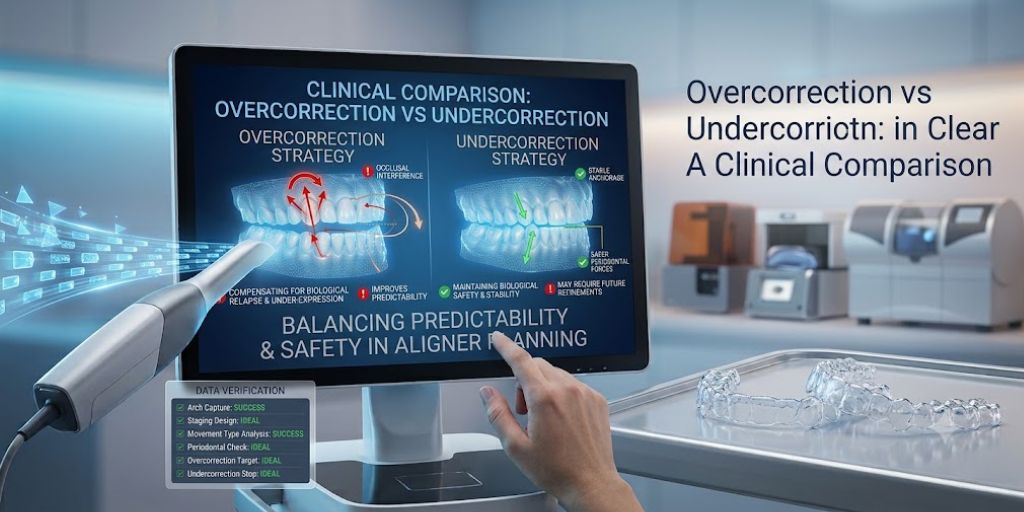
In clear aligner treatment planning, precision is not only about directing tooth movement, but it is also about anticipating how teeth will respond to that movement. This is where the balance between overcorrection and undercorrection becomes critical.
Both strategies are used in digital orthodontic planning, but they serve different purposes. Overcorrection compensates for predictable biological shortfalls, while undercorrection may be used to avoid overloading teeth or soft tissue structures.
Understanding when to use each approach is essential for achieving predictable outcomes and minimizing refinements.
Understanding the Core Concept
At a fundamental level, both overcorrection and undercorrection are adjustments made to the ideal final tooth position.
- Overcorrection means moving teeth slightly beyond the intended final position to compensate for relapse or under-expression.
- Undercorrection means intentionally stopping short of the ideal position to avoid biological or mechanical limitations.
These adjustments are not arbitrary. They are based on clinical experience, movement type, and known limitations of aligner biomechanics.
Why Overcorrection Is More Common in Aligners
Clear aligners have inherent limitations in force delivery, particularly in rotational and torque-heavy movements. Because of this, teeth often do not fully reach their digitally planned positions.
Overcorrection compensates for:
- Material elasticity of aligners
- Biological resistance of periodontal structures
- Minor compliance issues in patient wear
- Predictable relapse after aligner removal
For example, rotated canines frequently require slight over-rotation in planning because they tend to rebound after treatment.
When Undercorrection Becomes Necessary
While overcorrection is more widely used, undercorrection is equally important in specific clinical scenarios.
Undercorrection is typically applied when:
- Excessive force could damage periodontal structures
- Movement risk outweighs aesthetic benefit
- Biological response is uncertain
- Adjacent teeth stability must be preserved
For instance, in severe crowding cases, attempting full correction in a single stage may destabilize the arch. In such situations, planners may deliberately undercorrect early stages to maintain biological safety.
Clinical Trade-Off Between the Two Strategies
The decision between overcorrection and undercorrection is fundamentally a balance between predictability and safety.
Overcorrection improves long-term alignment accuracy but increases planning complexity. Undercorrection improves biological safety but may require refinements later.
This trade-off is central to digital orthodontic decision-making.
How Digital Planning Systems Handle Both Approaches
Modern 3D orthodontic software allows planners to simulate both strategies during staging design.
Overcorrection is typically integrated into final-stage modeling, where teeth are pushed slightly beyond target positions.
Undercorrection is applied during early or mid-stage planning when biological constraints are more restrictive.
Advanced systems even allow hybrid approaches, where certain teeth are overcorrected while others are undercorrected within the same treatment plan.
Impact on Refinement Rates
One of the most important considerations is how these strategies affect refinements.
Overcorrection, when well-calibrated, reduces refinements by compensating for expected relapse. However, excessive overcorrection can increase refinement needs due to patient discomfort or occlusal interference.
Undercorrection, on the other hand, often leads to predictable refinements because it intentionally leaves minor discrepancies unresolved.
The goal is not to eliminate refinements entirely but to control their magnitude and frequency.
Clinical Decision Factors
Several factors influence whether a planner chooses overcorrection or undercorrection:
- Tooth type (incisors vs molars)
- Movement type (rotation, intrusion, extrusion)
- Patient compliance expectations
- Periodontal health status
- Treatment complexity level
Experienced planners rely on historical case performance to determine the most appropriate approach for each scenario.
Final Thoughts
Overcorrection and undercorrection are not opposing strategies—they are complementary tools within digital orthodontic planning.
When used correctly, they enhance predictability, reduce treatment complications, and improve long-term stability.
The key to successful aligner therapy is not choosing one over the other, but knowing how to balance both within a structured treatment plan.