
Intraoral scanning has replaced traditional impressions in modern orthodontics, but the shift to digital dentistry has introduced a new dependency: scan quality.
Unlike physical impressions that can be visually inspected and corrected before casting, digital scans are often assumed to be “accurate by default.” This assumption is where many treatment planning issues begin.
In clear aligner therapy, intraoral scan quality directly influences segmentation accuracy, staging precision, and final treatment predictability. A poor scan does not simply reduce clarity—it distorts clinical decision-making.
Why Intraoral Scan Quality Is Clinically Critical
A digital orthodontic workflow is only as reliable as the data on which it is built. Intraoral scans form the foundation of every subsequent step:
- Tooth segmentation
- Occlusion mapping
- Attachment positioning
- Staging simulation
- Final aligner fabrication
If the scan is inaccurate, every downstream process inherits that error.
What makes this especially important in aligner systems is that treatment is pre-planned across multiple stages. There is no real-time adjustment mechanism once the aligners are manufactured, which means errors cannot be corrected easily later.
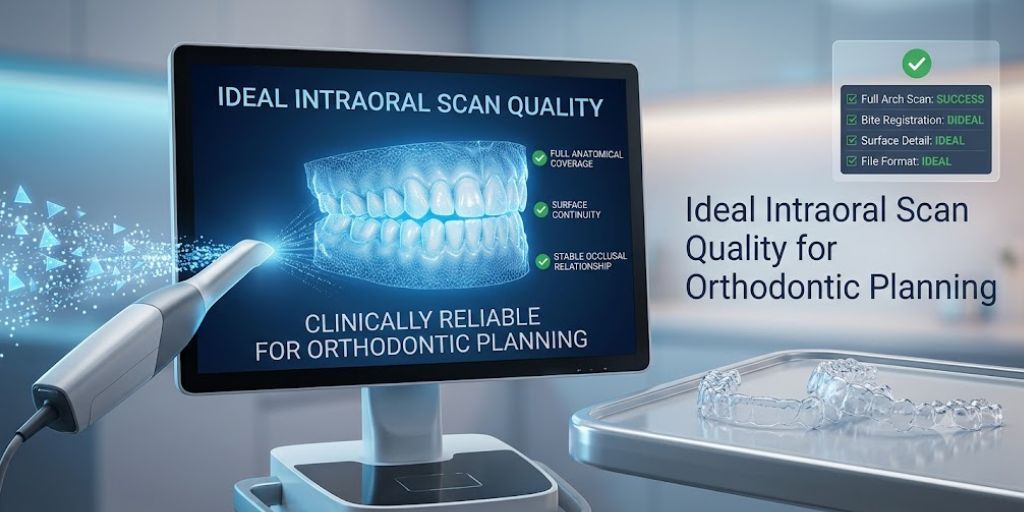
What Defines a High-Quality Intraoral Scan
A clinically reliable scan is not just visually complete—it must be structurally consistent and geometrically accurate.
One of the most important indicators is full anatomical coverage. The scan must extend to the most posterior teeth without truncation. Missing molars or incomplete distal capture often leads to incorrect anchorage planning.
Equally important is surface continuity. The scan should not contain breaks, holes, or duplicated mesh segments. These artifacts interfere with segmentation algorithms and can distort tooth boundaries.
A stable occlusal relationship is also essential. When bite registration is inaccurate, the entire treatment simulation becomes unreliable, particularly in cases involving crossbite correction or vertical adjustments.
Common Causes of Poor Scan Quality
Most scan issues are not caused by equipment limitations but by workflow inconsistencies.
One of the most frequent problems is saliva contamination during scanning. Reflections and moisture can distort optical capture, especially in posterior regions.
Another common issue is incomplete scanning sequence. Interruptions during arch capture often result in missing segments or misaligned stitching between scan sections.
Soft tissue pressure distortion also plays a role. Excessive retraction or probe pressure can flatten gingival contours, affecting attachment positioning and aligner seating accuracy.
Clinical Impact of Poor Scans on Treatment Planning
The consequences of low-quality scans extend beyond technical inconvenience. They directly affect clinical outcomes.
Incorrect segmentation can lead to inaccurate tooth movement simulation, particularly in rotational cases where contact points are critical.
Attachment misplacement is another major risk. Even slight geometric distortion can shift attachment orientation, changing force vectors in ways that are not clinically intended.
Over time, these inaccuracies often manifest as refinements, extended treatment durations, or compromised final occlusion quality.
Best Practices for Reliable Intraoral Scanning
Clinics that consistently produce high-quality STL files tend to follow structured scanning protocols rather than relying on operator variation.
A stable scanning workflow typically includes consistent arch sequencing, ensuring no section of the dentition is skipped or partially captured. This is especially important in posterior regions where alignment stability originates.
Dry field control is equally important. Minimizing moisture and reflection improves mesh stability and reduces artifacts.
Finally, immediate post-scan validation is essential. Reviewing STL completeness before submission allows early correction rather than downstream revision.
Connection to Outsourced Planning Efficiency
In outsourced orthodontic workflows, scan quality has a direct impact on turnaround time. High-quality scans allow planning teams to proceed immediately into segmentation and staging.
Low-quality scans introduce clarification loops, which slow down the entire pipeline. In fast-turnaround systems, such as 8-hour planning models, scan quality determines whether a case progresses smoothly or enters revision cycles.
Conclusion
Intraoral scan quality is not a technical detail—it is a clinical prerequisite. It defines how accurately digital systems can interpret anatomical structures and plan tooth movement.
Clinics that prioritize scanning discipline experience:
- More predictable aligner fit
- Fewer treatment refinements
- Faster planning turnaround
- Improved long-term outcomes
In digital orthodontics, precision begins at the moment of capture.